
The Seller Agent RFP - Evaluating AdCP Seller Agents for your Media Company
Introduction
The rapid advancement of Agentic Media Buying with AdCP is introducing the need for media companies and publishers to determine their supporting tech stack. This harkens back to the early days of programmatic, where a new buying channel spawned a slew of fragmented, siloed systems for publishers to manage the channel. Media companies have an opportunity to not repeat the same decisions forced upon them by programmatic and think more strategically about how they set up for success with AdCP.
For media executives, the technical question is no longer if you should deploy a seller agent, but how you should integrate it into your monetization stack. Media operations leaders have three distinct architectural paths. Evaluating them requires a strict look at total cost of ownership, technical fragmentation, and operational impact.
Option 1: Build a Proprietary In-House Seller Agent
This approach involves tasking internal software engineers with building an autonomous agent from scratch, coding the communication layer to support AdCP tasks, and hosting the agent endpoint yourself.
- The Pros:
- Total Data Guardrails: Your first-party data signals, audience data, and pricing floors never leave your proprietary cloud infrastructure.
- Custom Negotiation Logic: You can hardcode highly specific, bespoke packaging rules that perfectly reflect your unique sales philosophy.
- The Cons:
- The Integration Burden: Your engineers must manually build the translation layer between the AI agent's reasoning brain and your internal ad servers, inventory databases, and price management systems. Plus, the Seller Agent requires a UI for human-in-the-loop processes and sophisticated databases to support it.
- High Maintenance Costs: The AdCP standard will continuously evolve. An in-house build forces your product team to permanently absorb the engineering overhead of updating code, managing underlying models, and ensuring uptime.
- Speed to Market: Building a Seller Agent takes many months, as the latest version has very wide and deep requirements. Combine that with incomplete and misleading AdCP spec documentation, and engineers will find it requires more trial and error, slowing time to market.
Option 2: Buy an Independent Seller Agent (Direct-to-Ad-Server)
This model relies on purchasing a standalone, turn-key AI seller agent from an independent ad-tech vendor. The agent sits directly in front of your ad server (like Google Ad Manager or Xandr), handling incoming AdCP requests and executing placements via standard system connections.
- The Pros:
- Speed to Market: You can read the AdCP spec, configure the vendor's software, update your adagents.json file, and go live in a matter of weeks.
- Outsourced Upgrades: The software vendor absorbs the cost of maintaining the protocol standards and keeping up with the latest language model frameworks.
- The Cons:
- Operational Disconnect: Because the agent connects strictly to the ad server, it operates in a silo. It cannot see your wider business operations, meaning it cannot cross-reference contract terms, legal compliance, billing status, or historical client accounts. This creates yet another revenue silo requiring complex integrations to include AdCP into revenue forecasts, understanding client spend across channels, etc.
- Hidden Admin Costs: Seller Agents require rich product catalogs and pricing information. This adds an element of dual data administration or complex, costly integrations to external systems. Companies should question how the get_products natural language support for product recommendations really works under the hood and whether expensive AI RAG systems are a hidden cost and implementation.
- Complex Offering Limitations: if you’re routinely packaging multiple ad formats across several ad servers such as GAM, Adswizz, Freewheel, etc, many Seller Agents only support a single ad server. Additionally, buyers should evaluate multi-ad server support, how complex sponsorships and bundles/packages can be sold but executed with more complex underlying IO’s in the ad server.
- Dual-Entry Overhead: Your human traffic and billing teams will still have to manually re-key campaign details from the agentic ecosystem into your internal financial and reporting platforms.
Some media companies have evaluated the open source Prebid managed Seller Agent and found it has the same challenges as options 1 and 2 combined.
Option 3: Buy a Seller Agent Combined with a CRM and Order Management System (CRM+OMS)
The integrated approach natively combines an AdCP seller agent directly to your enterprise CRM + Order Management System (OMS). The AI agent acts as an autonomous sales coordinator that lives natively inside the core platform that already governs your product catalog, rate cards, contract management, financial invoicing, approval policies/rules, and ad-server delivery.
- The Pros:
- Unified Operational Truth: The agent does not just check ad-server availability; it checks real business rules. It reviews legal terms, active credit holds, and multi-channel packages (combining digital display, linear TV, and custom sponsorships) seamlessly. It eliminates yet another revenue channel silo, bringing all revenue streams under one umbrella for unified revenue forecasts, managing against Upfront Agreements, and client-specific pricing rules
- Automated End-to-End Billing: When a buyer's agent closes a deal via AdCP, the integrated system automatically creates the order, reserves the inventory, alerts the ad server, and generates the financial ledger in your billing system without a human touching a keyboard.
- Yield Optimization: The agent can balance programmatic automated demand against premium direct-sales contracts because it has a holistic view of your entire revenue operation.
- Single System of Record & Action: Having an integrated platform makes use of existing workflows such as advertiser setup, media plan creation and approval, IO creation and billing. A combined CRM+OMS provides a superior system of action for human-in-the-loop steps such as reviewing submitted media buys, adjusting how the plan is structured for sale vs execution across one or more ad servers, and all the compliance needs for auditability.
- Less Abandoned Shopping Carts: A combined Seller Agent CRM+OMS platform can enable tracking of buy requests that don’t convert to orders and suggest product catalog improvements to win more business. The Seller Agent should propose product and pricing changes to solve the eCommerce “abandoned shopping cart” problem inherent to AdCP’s buying spec.
- The Cons:
- Vendor Ecosystem Lock-In: You are dependent on your enterprise OMS vendor to build, support, and continually prioritize a premier AdCP agent layer.
- Onboarding Scope: Upgrading or configuring an enterprise OMS component requires cross-departmental coordination between finance, ad operations, and sales engineering teams.
Comparison: Evaluating the Three Architectural Paths
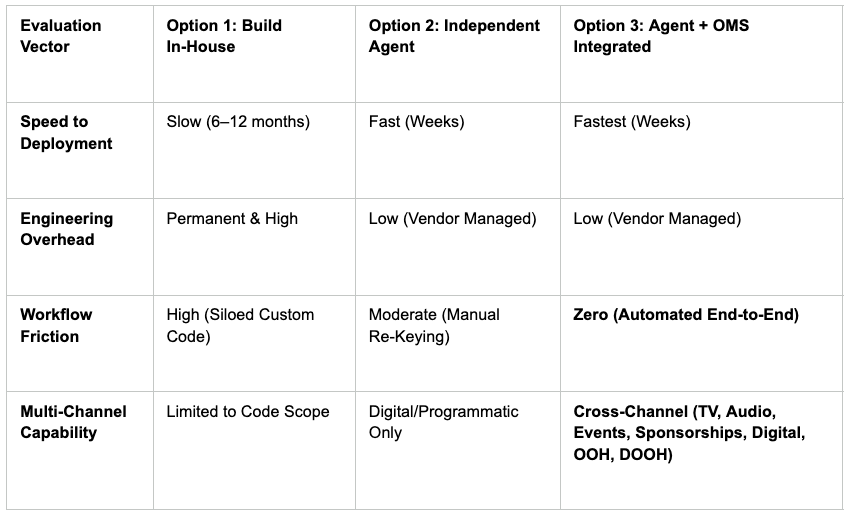
The Strategic Directive: Prioritize the Seller Agent OMS solution
When guiding your engineering and monetization teams, the executive recommendation is clear: Prioritize buying a seller agent that is natively combined with your CRM+Order Management System.
Why the OMS Wins: AdCP is not just an impression auction protocol like OpenRTB; it is a full campaign lifecycle standard. It handles everything from initial account creation and product discovery to transaction execution and unified reporting across multiple media types.
If you build in-house or buy a standalone point solution, you create another isolated digital silo. Your team will end up wasting time managing software connections and manually dragging data across systems. By integrating the AI seller agent directly into your OMS, you turn agentic AI into a natural extension of your existing business. This lets your business transact at machine speed while maintaining complete financial, operational, and legal control.
The Boostr POV
For the reasons outlined above, it became very clear the best solution for publishers is a Seller Agent combined with Boostr OMS. Anything else is a repeat of the same silos, complexity, and fragmentation introduced by programmatic. To see first-hand what a unified Seller Agent and OMS looks like, contact us here.
Media companies have an opportunity to avoid repeating the fragmented, siloed decisions forced upon them by early programmatic buying. While building in-house or buying an independent direct-to-ad-server agent introduces engineering overhead, operational disconnects, and manual re-keying, unifying an AI Seller Agent directly with your core CRM and Order Management System delivers zero workflow friction and end-to-end billing automation.
To guide your evaluation and discover how Boostr transforms revenue operations across the entire campaign lifecycle:
- Explore how the Boostr Order Management System eliminates revenue silos and unifies cross-channel execution.
- Learn how the Boostr Agent Series powers intelligent automation to streamline complex media workflows.
- View the full Boostr Platform Overview to see how our combined CRM, OMS, and AI capabilities deliver a single system of record and action.
Ready to see how an integrated Seller Agent and OMS platform can elevate your media business? Book a Demo today.
Empowering solutions don’t come without questions
What are the three architectural paths for deploying an AdCP Seller Agent?
Media operations leaders have three distinct architectural paths: Option 1 is building a proprietary in-house seller agent, Option 2 is buying an independent direct-to-ad-server agent, and Option 3 is buying a seller agent natively combined with a CRM and Order Management System (CRM+OMS).
What are the main drawbacks of building a seller agent in-house?
Building in-house creates a heavy integration burden between the AI agent and internal ad servers or databases, imposes high permanent maintenance costs as AdCP standards evolve, and slows speed to market (taking 6–12 months due to complex requirements and incomplete spec documentation).
Why do standalone direct-to-ad-server seller agents create operational friction?
Standalone seller agents operate in isolated revenue silos because they connect strictly to the ad server. They cannot view wider business operations like contract terms, legal compliance, billing status, or historical accounts, resulting in hidden admin costs, single ad-server limitations, dual data administration, and manual re-keying of campaign details.
Why is combining a seller agent with Boostr CRM+OMS the recommended strategic path?
Combining a seller agent directly with Boostr CRM+OMS creates a single system of record and action. It provides unified operational truth, automates end-to-end billing, optimizes yield across programmatic and direct sales, supports multi-channel campaigns (TV, Audio, Digital, Sponsorships, OOH, DOOH), and reduces abandoned shopping carts
Boostr is the only platform that seamlessly integrates CRM and OMS capabilities to address the unique challenges of media advertising. With boostr, companies gain the unified visibility necessary to effectively manage, maximize and scale omnichannel ad revenue profitability with user-friendly workflows, actionable insights, and accurate forecasting.
Book a demo