
AI Agents - Build vs Buy?
Navigating the AI Frontier: Should Your Company Build or Buy Agentic AI Systems?
As executive teams look to capture the operational efficiencies promised by artificial intelligence, "Agentic AI"—systems capable of executing multi-step business processes autonomously—has moved to the top of the strategic agenda.
However, leadership teams are quickly encountering a classic operational crossroad: Should we build these autonomous agent systems in-house, or buy them from an external vendor?
While advanced development tools make building a basic prototype easier than ever, the long-term cost of software ownership remains high. For leadership, the decision should not be driven by technical novelty, but by a clear-eyed assessment of competitive advantage, speed-to-market, and total cost of ownership.
The Executive Summary: Buy What is Utility, Build What is a Weapon
Before diving into a complex evaluation, a reliable rule of thumb applies to the modern technology stack: Buy what you can, build only what you must.
If an AI agent handles standard corporate functions—such as processing customer service tickets, automating IT support, or managing ad trafficking and invoices—you should buy a working vendor solution if one exists. Your core business is not AI infrastructure, and a vendor allows you to scale immediately.
Conversely, if the AI agent is directly tied to your proprietary data, acts as your primary customer experience, or forms the "secret sauce" of your market differentiation, a custom build becomes a viable strategic weapon.
Weighing the Approaches: Pros and Cons
To guide your executive committee, it is critical to understand the long-term trade-offs of both strategies.
Option A: Buying a Packaged Vendor Solution
Purchasing an established platform means you are buying a vendor's operational maturity, built-in security compliance, and thousands of hours of edge-case testing.
- The Pros:
- Rapid Time-to-Value: Go live in weeks rather than quarters, capturing an immediate return on investment.
- Predictable Economics: Subscription fees offer budgeting clarity, shifting the cost from a massive capital expense to a predictable operating expense.
- Outsourced Maintenance: The vendor handles software updates, model drift, security patches, and broken system connections.
- The Cons:
- Rigid Capabilities: You are tied to the vendor’s product roadmap and configuration limits.
- No Unique Intellectual Property: Your competitors can buy the exact same operational efficiency.
Option B: Building a Custom In-House System
Building means assembling an internal team to stitch together artificial intelligence models, data pipelines, and system permissions into a custom application.
- The Pros:
- Absolute Customization: The system can be molded perfectly around highly unique or proprietary workflows.
- Data Sovereignty: Ideal for highly regulated industries where sensitive data cannot leave a private corporate network.
- The Cons:
- The Maintenance Iceberg: Building a working demo is fast, but maintaining it is incredibly difficult. Your internal engineering team must permanently own the responsibility of fixing bugs, managing model updates, and monitoring safety guardrails.
- High Opportunity Cost: Every engineer tasked with building foundational AI infrastructure is an engineer pulled away from your core business products.
The Executive Decision Framework
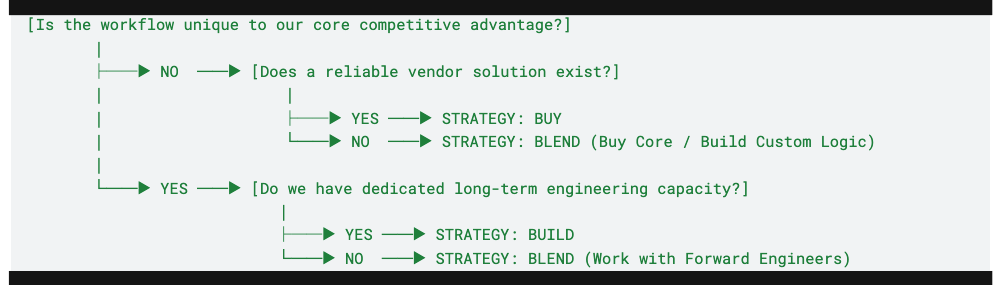
To move past theoretical debates, use this structured four-part framework to evaluate every proposed AI agent project.
1. Strategic Differentiation
- The Question: Does this specific agent workflow generate a defensible market advantage or direct revenue for our company?
- The Rule: If the answer is no, it is an operational utility. Look to the vendor market immediately.
2. Time-to-Market vs. Competitive Window
- The Question: What is the financial cost if we delay deployment for 12 to 18 months while we build this from scratch?
- The Rule: If your market is moving rapidly, buying gets you into the game instantly. You can always iterate or migrate later once you better understand your organizational needs.
3. Real Total Cost of Ownership (TCO)
- The Question: Have we priced the long-term cost of owning this software, including data engineers, continuous testing, and infrastructure overhead?
- The Rule: Industry averages show that building and maintaining a custom multi-agent enterprise system over three years is often significantly more expensive than paying a platform subscription fee.
4. Operational Maturity
- The Question: Does our organization possess the specialized talent required to monitor autonomous systems, enforce security guardrails, and prevent unintended system actions?
- The Rule: If your internal technical team is already stretched thin, buying allows you to leverage the vendor's dedicated operational muscle safely.
The Pragmatic Path Forward: The Hybrid Model
For most enterprise organizations, the final decision is rarely a binary choice between building or buying. The most successful implementations utilize a Hybrid Approach.
Under this model, you purchase a robust, secure, vendor-supported core platform that handles the heavy lifting—such as security permissions, data integration, and system monitoring. Then, the vendor or your team adds a customized layer of business logic on top of that vendor foundation. This approach delivers the best of both worlds: the rapid deployment and security of buying, combined with the targeted customization of building.
The Boostr POV
We’re firmly in the camp of “if you can buy it and customize it, you should”. In our experience working with hundreds of media companies, everyone does the same thing often with different steps, data, policies and other nuance. Rigid agents won’t get the job done. They should be highly configurable to your specific requirements. The Boostr Agent Series is a collection of role based Agents that provide 75-100% of your needed capabilities. Our agentic infrastructure is designed from the ground up to provide clients the best of customization capabilities with faster time to market and industry best practices. The Boostr Agents combined with the Boostr CRM and/or OMS provides an unparalleled platform for Agentic Excellence for high fidelity data, workflow context and user experience. To learn more about the Boostr Agent Series visit us at www.boostr.com/agent-series or schedule an appointment here.
Achieving Agentic Excellence with Boostr
When navigating Agentic AI, the proven rule of thumb is to buy what you can and build only what you must. Because rigid agents cannot handle enterprise nuances, your systems must be highly configurable to your specific workflows.
The Boostr Agent Series provides role-based agents that deliver 75–100% of your required capabilities out of the box. Built on agentic infrastructure designed for rapid customization, faster time-to-market, and industry best practices, it seamlessly integrates with Boostr CRM and OMS to form an unparalleled platform for Agentic Excellence.
Ready to transform your operational efficiency without the maintenance iceberg? Book a Demo today to see Boostr in action.
Empowering solutions don’t come without questions
Should our company build or buy Agentic AI systems?
Executive teams should follow a simple rule of thumb: buy standard corporate utilities and build only proprietary competitive advantages. If an AI agent handles standard functions like customer service, IT support, or ad trafficking and invoicing, buy a vendor solution to achieve immediate scale and rapid time-to-value. Build in-house only if the system involves proprietary data, serves as your core customer experience, or forms your primary market differentiator.
What are the pros and cons of buying a packaged vendor AI solution?
Buying a packaged solution offers rapid time-to-value in weeks, predictable operating economics, and outsourced maintenance for security patches, model drift, and system updates. The primary trade-offs are rigid capability boundaries tied to the vendor's roadmap and a lack of unique intellectual property.
What are the main trade-offs of building a custom in-house AI agent?
Building custom AI agents provides absolute customization for unique workflows and complete data sovereignty within private corporate networks. However, it introduces a heavy "maintenance iceberg"—requiring continuous bug fixing, model monitoring, and guardrail enforcement—while pulling valuable internal engineering resources away from core business products.
What is the hybrid model for Agentic AI implementation?
The hybrid model combines the speed and security of buying with the flexibility of custom building. Under this approach, an organization purchases a vendor-supported core platform for security, data integration, and system monitoring, while configuring a customized layer of business logic on top to meet specific operational requirements.
Boostr is the only platform that seamlessly integrates CRM and OMS capabilities to address the unique challenges of media advertising. With boostr, companies gain the unified visibility necessary to effectively manage, maximize and scale omnichannel ad revenue profitability with user-friendly workflows, actionable insights, and accurate forecasting.
Book a demo