
Beyond Programmatic: Navigating the 5 Stages of the Agentic Media Buying Maturity Model
Digital advertising is undergoing its biggest paradigm shift since the rise of programmatic RTB (Real-Time Bidding). While automated bidding platforms replaced manual ad placement, they still required humans to configure rules, define targets, and constantly manage knobs and levers. Ultimately, many media companies failed to realize the promise of programmatic, sometimes referred to as “programmanual” due to the intensive manual tasks, race to the bottom CPMs and lost revenue. 50% or more of ad spend goes to intermediaries instead of working media. And programmatic doesn’t work for traditional ad formats like Radio, TV, Print and Out of Home and isn’t ideal for newer digital formats like Podcasts, Streaming Audio and CTV.
Enter Agentic Media Buying—a paradigm where AI agents on both the demand side (buyers) and supply side (sellers) negotiate, optimize, execute, and settle ad campaigns directly with one another. A new way of transacting for all media types, not just for digital advertising. Conceived by the creators of the programmatic ecosystem, Agentic Media Buying promises to solve many of the programmatic challenges while also improving outcomes for marketers. The potential impact for the industry is compelling for all parties involved and could be the saving grace for publishers as they’re under attack from Generative AI and the walled gardens.
Transitioning to fully automated Agentic media workflows doesn't happen overnight. Organizations progress through distinct evolutionary phases as trust, data integration, and system interoperability mature.
The Agentic Media Buying Maturity Matrix
The matrix below maps the progression from one off, human-driven test buys to a fully integrated ecosystem where AI agents manage the vast majority of media investments.
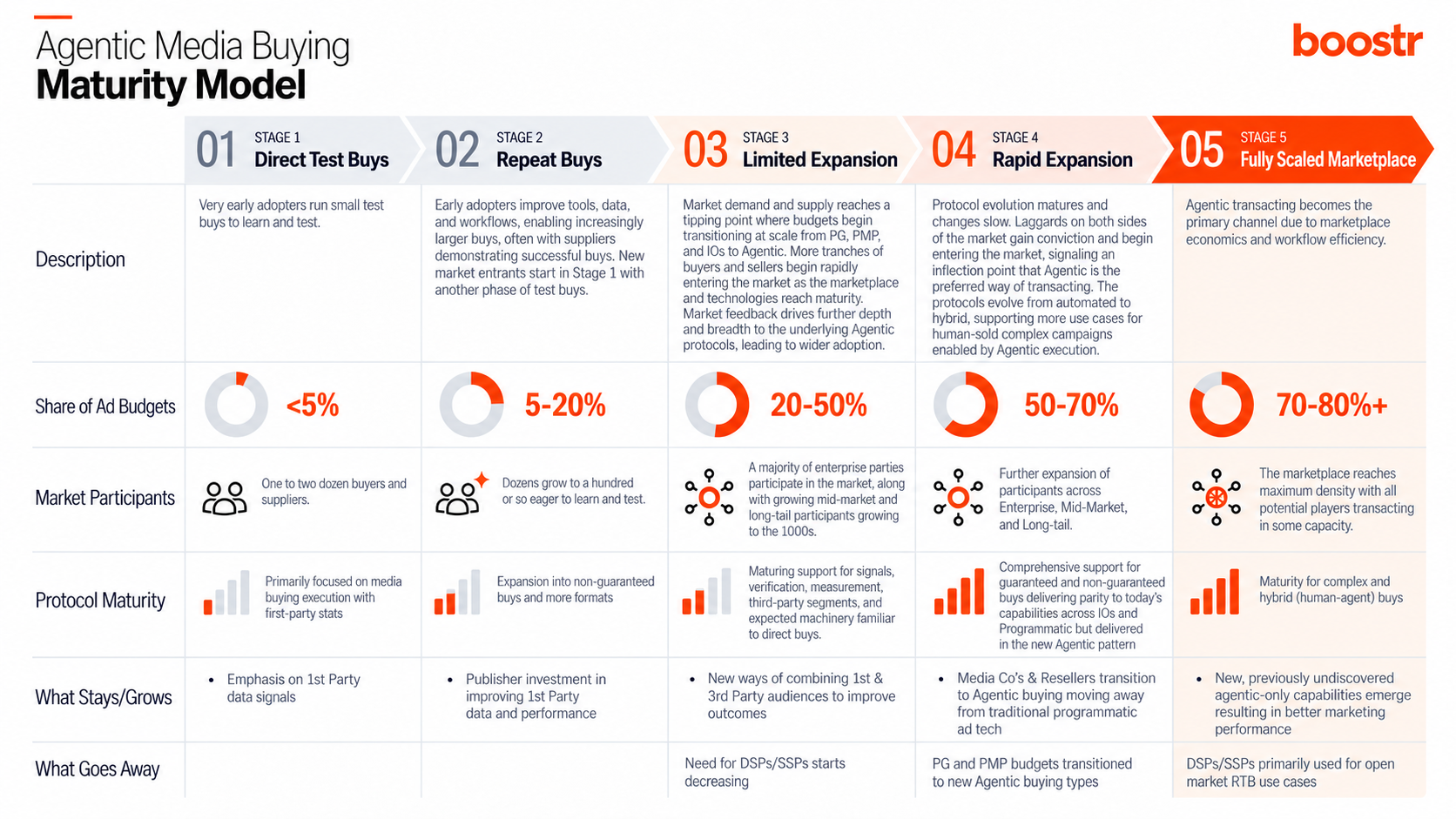
Breakdown of the 5 Maturity Stages
Stage 1: Direct Test Buys
In the initial stage, teams experiment with early to market buyer and seller agents automating basic workflow. Buys are predetermined (formats, flight dates, budgets, etc) using small test budgets for all parties to learn how the technology works and resolve technical issues.
Stage 2: Repeat Buys
Here, buyers and sellers increase their confidence in the agentic buying channel after executing test buys. Buyers start moving briefs into agentic buys as their confidence levels increase for a cohort of known, trusted sellers. Sellers prioritize product catalog design and breadth of available products to improve win rates for agentic buys. For early adopters, the agentic buying channel becomes tangible as buys start executing without pre-orchestration between buyers and sellers.
Stage 3: Limited Expansion
In Stage 3 direct buying channels accelerate migrating to agentic with IO’s, PG and PMP budgets leading the way. Buyers get more confidence and sophistation with their tools to understand how to improve the performanc of their spend. Familiar, important capabilities from programmatic such as measurement, attribution, frand prevention have reincarnated in new agentic formats paving the way for significant share shift. On the sell side, similar confidence increases as media companies start optimizing the new agentic channel as it brings meaningful revenue from new and existing buyers. Not only has the sell side figured out which products and solutions provide the best option for buyers in an agentic world, new ad products enabled by agentic start appearing delivering superior marketing performance.
Stage 4: Rapid Expansion
By stage 4, the agentic protocol has matured so that’s it no longer a blocker for moving budgets in mass. Buyers can find and buy any format - traditional, digital, social, etc. Many of the complexities around premium offerings (sponsorships, custom activations, etc) are solved with a hybrid agentic-human motion. Combining the best of agentic intiatied, human assisted, buyers and sellers move beyond automation bringing out the best in human creativity and relationships. The market realizes agentic isn’t a replacement for the people; it’s a complement and helps elevate them to more strategic work, replacing spreadsheets, siloed systems, and endless data reconciliation. As a result, programmatic budgets decline rapidly in favor of agentic, with all parties across the market participating.
Stage 5: Fully Scaled Marketplace
In the final stage, confidence is high, capabilities are robust, leading to a scaled, mature marketplace. Programmatic as we knew it is largely dead. Buyers see better marketing performance; media companies regain financial health as more money goes to working media, improving margins and sustainable growth.
Conclusion
The transition to agentic advertising is both exciting and disruptive. Not everything we know today will survive; new categories, solutions, and companies will emerge and thrive. How long this takes, no one really knows, but we’re solidly in Stage 1 today.
There hasn’t been a more exciting time to be in the industry since the advent of programmatic in the early 2000s. This time around, we’re confident the industry has learned from its mistakes and will build a bright future for advertising. Marketing will never go away; it just keeps evolving. Agentic advertising is the new growth surface for the future.
For publishers preparing for that future, Boostr’s AdCP Seller Agent launches an automated direct buying lane that connects premium inventory to buyer-side AI agents via AdCP, while publishers keep control of packaging, pricing, access, rules, and approvals.
Every agent in the Boostr Agent Series is built on AdCP, the same open standard. Together, they shift your team’s time from manual busywork to strategic acceleration:
- Media Planning Agent imports outside media plans and insertion orders and converts them into plans that work in Boostr.
- Contact Agent turns email correspondence into clean, enriched contact records, so your CRM stays ready for sales.
- Delivery Reporting Agent automatically reconciles first-party and third-party delivery data, cutting manual updates and speeding up closing.
- Trafficking Agent handles creative intake, tagging and QA, so campaigns launch faster with fewer errors.
Want to learn more? Click here to read our eBook, From Manual to Intelligent: Harnessing AI Agents for Next-Generation Advertising Efficiency.
Ready to see it in action? Book a demo for a personalized walkthrough of how the AdCP Seller Agent connects your premium inventory to buyer-side agents.
Empowering solutions don’t come without questions
What is agentic media buying?
Agentic media buying is a way of transacting where AI agents on both the buy side and the sell side negotiate, optimize, execute and settle ad campaigns directly with one another. It works for all media types, not just digital advertising. Conceived by the creators of the programmatic ecosystem, it aims to solve many of programmatic's challenges while improving outcomes for marketers.
Why didn't programmatic advertising deliver on its promise?
Programmatic automated bidding, but humans still had to configure rules, define targets and constantly manage knobs and levers. That's why it's sometimes called "programmanual." Many media companies were left with intensive manual tasks, race-to-the-bottom CPMs and lost revenue, while 50% or more of ad spend goes to intermediaries instead of working media.
Which ad formats does programmatic struggle to support?
Programmatic doesn't work for traditional ad formats like radio, TV, print and out of home. It also isn't ideal for newer digital formats like podcasts, streaming audio and CTV. Agentic media buying is designed as a new way of transacting across all media types.
What happens to DSPs, SSPs, PG and PMP budgets as agentic buying grows?
Their role shrinks stage by stage. In Stage 3, the need for DSPs and SSPs starts decreasing. By Stage 4, PG and PMP budgets have transitioned to new agentic buying types, and by Stage 5, DSPs and SSPs are primarily used for open market RTB.
Will agentic media buying replace media sales and buying teams?
No. Agentic isn't a replacement for people; it's a complement that elevates them to more strategic work, replacing spreadsheets, siloed systems and endless data reconciliation. Complex premium offerings, like sponsorships and custom activations, are handled with a hybrid agentic-human motion.
What are the 5 stages of the agentic media buying maturity model?
The five stages are Direct Test Buys, Repeat Buys, Limited Expansion, Rapid Expansion and Fully Scaled Marketplace. Agentic's share of ad budgets grows from under 5% in Stage 1 to 5–20%, 20–50%, 50–70% and finally 70–80% or more. Each stage reflects growing trust, data integration and system interoperability.
What stage of agentic media buying is the industry in today?
The industry is solidly in Stage 1, Direct Test Buys. Very early adopters run small test buys with predetermined formats, flight dates and budgets to learn how the technology works and resolve technical issues. How long the full transition takes, no one really knows.
How can publishers prepare for agentic media buying?
Start with product catalogs and first-party data. In Stage 2, sellers prioritize product catalog design and the breadth of available products to improve win rates for agentic buys. First-party data signals gain emphasis early, and publishers invest in improving their first-party data and performance.
What are the benefits of agentic media buying for marketers and publishers?
In a fully scaled agentic marketplace, buyers see better marketing performance. Media companies regain financial health as more money goes to working media, improving margins and sustainable growth. For publishers under pressure from generative AI and the walled gardens, agentic buying could be a saving grace.
About Boostr
Boostr is the most comprehensive and accurate digital transformation platform for managing advertising sales and delivery in the media industry. Purpose-built by media professionals, Boostr offers CRM, OMS, automated RFP response tools, and the Boostr Agent Series, a powerful suite of AI assistants designed to streamline workflows and drive smarter decisions across the revenue org.
Boostr’s solutions integrate seamlessly with your preferred apps and systems, from ad servers and DSPs to marketing automation and ERP/Finance tools, ensuring your teams can work the way they want while maximizing value. This approach enhances productivity and eliminates data latency that comes from manual syncing, so you always have the real-time information you need.
Boostr is the only platform that seamlessly integrates CRM and OMS capabilities to address the unique challenges of media advertising. With boostr, companies gain the unified visibility necessary to effectively manage, maximize and scale omnichannel ad revenue profitability with user-friendly workflows, actionable insights, and accurate forecasting.
Book a demo